
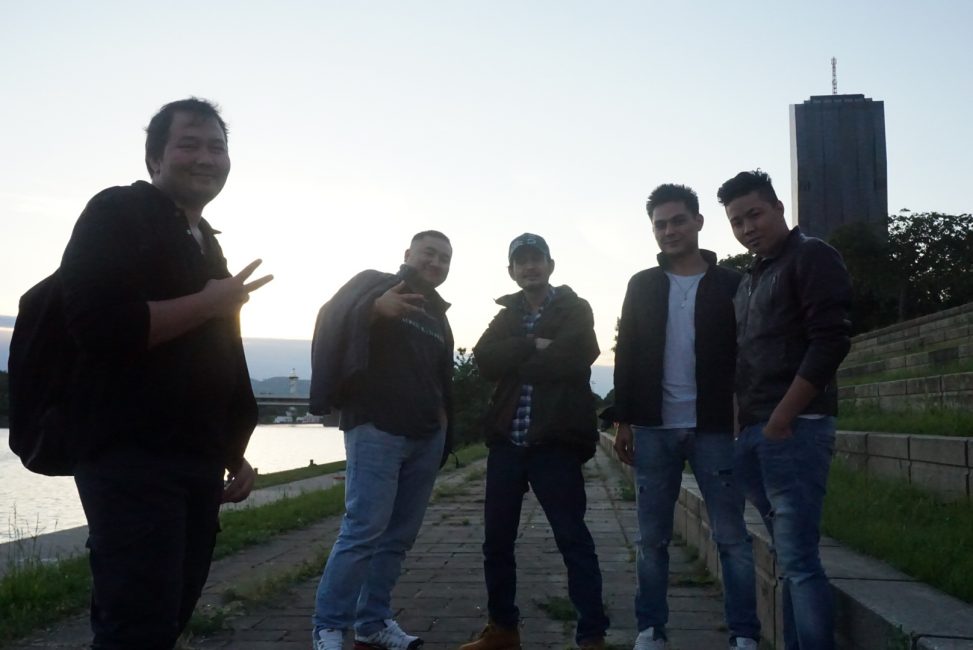
AJ Naddaff, Arab Studies and Political Science
This trip reaffirms the baggage of privilege that comes with being an American in a global context. For one, when I speak English on the streets, I am easily understood and looked up to. I have even heard Austrians apologize to me, a foreigner in their country, for not being able to speak English as properly as they would have liked. English is chic and more; it is ubiquitous, having become necessary for success in the 21st century market. In the words of one Austrian, everyone who has university education can speak it. Of course, I recognize that my acceptance in society and the ease I have traveling throughout Vienna also has to do with my skin color, and that I do not visibly appear like, or carry the accent of, the “other.” It can be assumed then that Americans are not an excluded group in Austria, whether visiting as tourists or moving to Vienna to inherit the smug, socially constructed title of the expatriate. (Be wary, this title only applies to the white race and specific countries of origin!) This brings me to larger abstract questions:
Who is accepted by Austrian society, who are the out groups, and who are the “true” Austrians?
These questions have been explored and expressed in various interdisciplinary capacities over the first half of our trip, from theatrical performances and art exhibitions to lectures by Bruce Leimsidor, a European asylum expert, Katharina Benedetter, the Head of the Integration Unit at the International Organization for Migration, and perhaps most explicitly in a seminar held yesterday by Sociologists Drs. Natalie Deckard and Alison Heslin.
My acceptance by Viennese society is not a direct reflection of Austria’s societal perception of Americans but an epiphenomenal response to the luxury of the American when traveling throughout the world. My privilege has much to do with the developed, affluent status of my country of origin, and the power associations with the English language. The question of who is an Austrian is far more contentious, unveiling a “labyrinthine complexity of historical ‘Austrian’ identity[1].” I ambled in the dimly lit Wunderbar late one night and engaged in lengthy conversation with a history teacher who vehemently argued that Austrian, and specifically Viennese, identity must be understood within an Eastern European ideological framework. Indeed, the iron curtail was mapped around Austria, and so Austria never fell under the power of the Soviet Union, but if you look at the populous, many Austrians have Slovak surnames. The recent university graduates gathered around the table unanimously agreed that Austria should be thought of in terms of Eastern European ideology. Professor Utkin from Davidson’s Russian and Gender and Sexuality Studies is one of the many who would find fault in this identification from an academic understanding, and perhaps this distinction is not even necessary. Rather, a better question might be, under what conditions is one excluded from Austrian society, discriminated against, undesirable, and made to feel like the “other”?
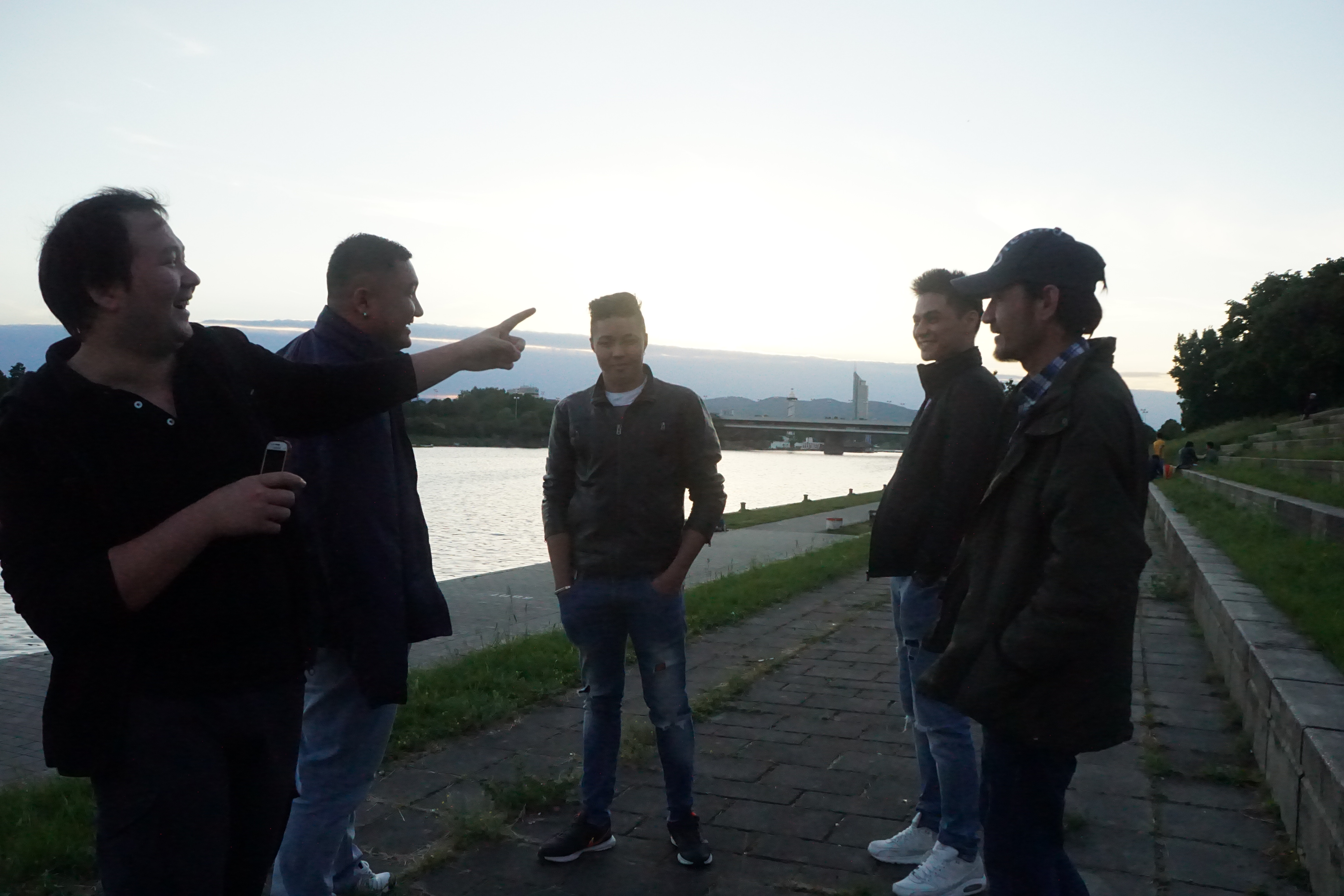
When asking a group of Afghan teens if I could take a picture of them they reluctantly agreed, only after explaining: “We don’t like the press. They write bad things about us.”
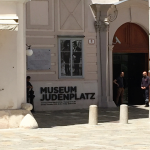
The difference between migrants and refugees becomes blurred when society and domestic policies do not care about understanding their differences. To them, these people are all foreigners, and foreigner’s definitions have changed depending on the political usefulness of the situation, as portrayed through certain heuristic delineations. When the Berlin wall crashed, refugees escaping the big bad Soviet became dirty migrants overnight. In the U.S. context, refugees from Honduras, Mexico and other parts of Central America fleeing civil wars to arrive to America are pejoratively called illegal immigrants. In Europe, however, this is referred to as our refugee crisis. Dr. Deckard introduced us to sociologies Thomas Theorem which states that if we imagine situations to be real, they are real in their consequences. Clearly much of European society has work to do in combatting the perceived notion that migrants and refugees are hermetically sealed, entirely different, and homogenous populations whose cultures are at threat with those of “true Europeans.” As discussed, identities and in groups are always changing, and the idea of a true Austrian identity is now a hoax. Groups like Refugees Welcome should be applauded for the steps they take in overcoming many of the integration problems that first came with “guest workers” in their efforts to better integrate the new waves of refugees from countries like Afghanistan and Syria. For the second half of my trip, I am excited to continue grappling with questions on the migration narrative. Later today, we will learn about how Jews became the scapegoat, similar to many Muslims in Europe today, and were stripped of citizenship so no state could protect them in the rise of World War II. In the next day or so, I plan to return to the Donau park and to speak to those placed under the ‘other’ label, refugees and/or economic migrants predominantly from the Arab world to learn about their experiences in Austria. Above all, I’m thankful for what this trip has done in awakening my recognition of the inordinate privilege I carry as an American in our globalized world.
[1] Beller, Steven. A Concise History of Austria (Cambridge Concise Histories). Cambridge University Press. Kindle Edition.
