



Emma Cardwell
Längenfeldgasse U-Bahn station on the U4 lies on the Eastern part of the city. When we stepped out of the station to head toward Cafe Prosa
last night, an eerie wave of nostalgia hit me. The graffitied walls, many-windowed apartment complexes (certainly more reminiscent of Berlin’s Plattenbau architecture than any building near Josefplatz or Heldenplatz), the dirtied streets, and the larger number of young people riding their bikes reminded me of the neighborhood of Kreuzberg in Berlin.
Längenfeldgasse rests parallel to the “Wiener Fluss” or Vienna stream, in the working class district of Meidling. The stream resembles a canal, and drops down far below the line of the street. As we crossed the bridge over the stream, we spotted no tourists, a sharp contrast to the areas we’d been in earlier in the week. No wealthy, middle-aged women in pastel-colored pants with glowing tan skin and gold jewelry. No little dogs on short leashes. On the street were young men smoking, strolling. We passed dark bars with open doors in the basements of buildings with music playing softly.
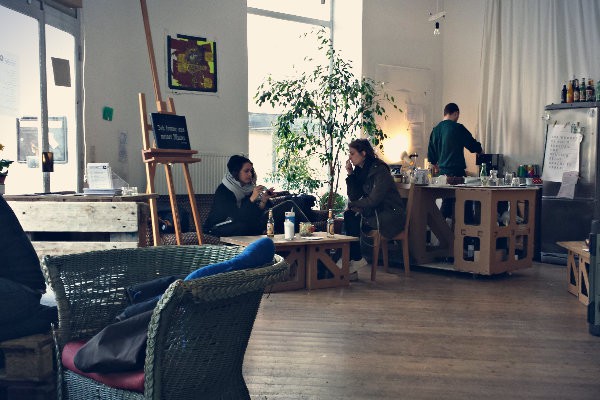
I was expecting Cafe Prosa to be a chill bar with candles and dusty tables. But when we arrived, I was surprised: it was more of a rec-room with high ceilings and white boards, chairs, and lounge chairs scattered around. Some twelve people sat hunched over a long yellow table, where boxes of board games and card games were scattered.
We sat down at the table across from an Austrian mother and her young son, Gregor, and a young man who I assumed to be a refugee living with their family. Unfortunately, we were never officially introduced. Before long, a couple other young girls arrived and sat down next to us. One of them was a student and the other, a young woman who was born in India but grew up in Vienna. We began to play a game somewhat like Taboo, in which one person describes an object pictured on a card, without saying the name of the object. When deciding whether we would play in English or German, the Austrian mother was adamant about using German. When someone suggested English, she guffawed and let her Wiener Schmäh rip, telling us that would be absurd, since the refugee and her son knew only German. But half of us Americans couldn’t speak German. So we came to a compromise: we would alternate between both languages.
The snarkiness of the Austrian mother seemed to me a bit uncalled for. I assumed that the event, sponsored by Refugees Welcome and OpenSchool Wunschbörse, would be a welcoming space, where anyone who came would feel comfortable, as long as they cared about the cause and were open to meeting others. But this mother seemed exasperated with the fact that English-speakers would not be able to communicate with the refugee living with her.
As we have learned, refugees must enroll in German classes when they gain refugee status in Austria if they hope to gain further vocational training and get a job in the country. Therefore, it may have seemed rude to the mother that people who came to the Stammtisch in order to integrate with refugees did not care about communicating with them in German.
Later in the evening, I had a different experience talking with a man who didn’t know German very well at all. Dinner was served after sunset because of Ramadan and Kelly and I sat down on the couch to eat our food, a baked pita bread stuffed with soft-cooked vegetables, dipped in yogurt sauce. After we told a man from Afghanistan that we were from the USA, he told us his nickname is Jackie Chan. His face lit up, as if to say, “You know him! Jackie Chan! You are from the USA!” Then he said, “I am from Afghanistan, but I look like I am from China. Makes no sense. People don’t understand.” He told us that he had recently been denied access to stay in Vienna after two years of living here, because he failed an interview. I’m not sure what this interview was, but I assume it was held to check whether or not he should be permitted to stay in the country.
In broken German, he explained that he is a karate teacher in Vienna, and also takes dance classes. What he was sharing wished to express that he had integrated into society. But when I asked him how he came to know Refugees Welcome, he couldn’t seem to understand. I asked in both German and English, but his ability was not strong enough, so he asked his friend to come over and translate. I asked how Jackie Chan had come to know everyone, and his friend told us that they had met in dance class. Jackie Chan’s friend is also from Afghanistan, but his family moved to Canada before coming over to Europe. We began discussing his current living situation: he works in Berlin as a fashion designer.
Jackie Chan lost interest in the conversation, and turned to show me pictures of himself dancing and doing karate. He pointed to the individuals in the pictures: “There, Austrian. There, American. My students.” The pictures showed him in colorful dance costumes in a studio, and doing karate poses on the lawn in front of a large baroque-style building. He then interrupted his friend and began speaking in what I assume was a language of Afghanistan: Dari or Pashto. He was excited, talking fast. Finally, his friend cut him off, and turned to us. “He wants to immigrate to the USA, and wants to know if you can help him. Do you know how to do this?”
Kelly and I looked at each other in disbelief. Could we help him? Of course not. We didn’t know what to do, how to answer Jackie or his friend. We shook our heads and tried to think of something. Kelly assured him, “We don’t know. We don’t work for the government. I don’t know how to get you a passport.”
I tried to change the subject and ask how Jackie liked living in Vienna, but he kept repeating the same question in Dari to his friend: “Can they help me get to the USA?”
I don’t know where Jackie Chan lives or who he lives with, if it is through the Refugees Welcome program or not. I didn’t have a chance to ask. What I do know is that he seemed desperate. Tired. Distressed. Worried about his future. Where was he going to go? How would he get there?
Furthermore, I wondered, had the Austrian mother ever met Jackie Chan and tried to talk with him? Had she grown exasperated at his poor German? Would she want to help him, or would she be wary of his denied-interview status and not be interested?
At the Refugees Welcome Stammtisch I got to know a bit more about the type of people who are concerned and interested in helping refugees integrate into Austrian society. All week, we’ve been discussing the terminology, the statistics and the facts: who is a refugee and who is a migrant, how many refugees from different countries migrate to Europe, how they gain migrant or refugee status, how they get jobs. But for the first time, I met with refugees themselves, and the Austrian people who are living and working with them. They are not all friendly. Some are impatient, tired.
Refugees and the people helping them are juggling many challenges. Friends of refugees want them to learn German, meet others, integrate. But like the Austrian mother whom I met, they may lack the patience to deal with people who can’t contribute directly to the importance of their mission (our non-German-speaking Americans), although these same people may want to learn more about how to help.
Refugees themselves are not subjects to be interviewed, or studied. Jackie Chan was not going to tell us his life story, and it was hard to speak with him once our American identity got in the way. As soon as he found out we were from the USA, he saw us more like the key to a gate into our country, not people he would want to chat with. At the end of the day I realized that the community of people interested in supporting refugees is a complex one, and I look forward to talking with the Refugees Welcome leaders tomorrow.
PC: theloop.vienna2.com
