

EJ Canny
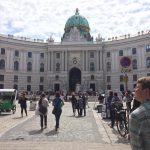
For the entirety of this trip, I’ve been viewing many things from Vienna in contrast to their German counterparts in Berlin. Some of the differences have been rather striking. Vienna has much more of an imperial history than Berlin, so there are many palaces left throughout the city that invoke the historic grandeur of an Imperial Austria. This is rather different than the industrial and efficient layout of Berlin.
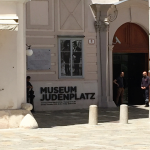
A more striking difference than this visual one is the placement or lack of public memorial spaces in Vienna and Berlin. Today, when visiting the Jewish Museum on Judenplatz, we got to see the memorial to the Holocaust. It was a rather powerful memorial and it was unavoidable as I walked through this square. The problem was that this square was secluded from any major thoroughfare and to access it we had to walk through smaller alleys. The square had very little foot traffic and those that were passing through seldom stopped to acknowledge this soul-crushing memorial about a vital time in Austrian history.
Contrast that image with the image of the Memorial to the Murdered Jews of Europe in Berlin, just blocks from the Reichstag building. Berlin’s memorial is placed right on a major street with heavy foot traffic, you can’t miss it if you walk by. If you choose to engage with it, it truly feels suffocating. Standing next to it and looking down the street, you see the Brandenburg Gate and the Reichstag. These are iconic German structures and also the German government and this memorial is placed in clear sight from either. The Austrian memorial is not nearby the parliament building. It isn’t next to the most iconic landmark of Austria or Vienna. It is in a small square, removed from the public eye.
The placement of this memorial is iconic of the lack of accountability that Austria feels for their past and current actions towards minority groups. The memorial in Judenplatz serves only to commemorate the Jewish victims of the Holocaust, not the homosexual and Roma victims or the victims of the T4 Action that institutionalized euthanasia of the physically and mentally disabled in Nazi Germany. In Berlin, these memorials are all within a kilometer of each other in Tiergarten, right next to the Reichstag and in the city center. In Vienna, I have yet to see a memorial to any of these groups and I have been doing quite a bit of walking through the center of the city. Memorials to these groups very well may exist, but they are most certainly not placed in a way where they are unavoidable as they are in Berlin.
It appears Austria’s lack of public accountability for their past could contribute to the strength of the far right in the present. The block that the apartment I’m staying in has some graffiti on it. I’ve seen a lot of graffiti around the city and I saw a lot of graffiti in Berlin, so I was initially unfazed. From a distance, it appeared to be kind of nice, an image of an Austrian helping refugees with the words “Refugees Welcome” boldly emblazoned on the image. As I got closer, however, I saw a lighter paint had been used to cross out the original image and its hopeful and multicultural message. Someone had put a green X through this image and painted “NO” just to the left. I thought back to Berlin to see if I remembered seeing any graffiti as blatantly anti-migrant as this was. I couldn’t think of any, although I’m sure there is somewhere in the city, but not as close to the center as this apartment. Not a few blocks from the staunch reminder of a past rooted in attempting to extinguish multiculturalism. Maybe if Austria was more accountable for their own past, I wouldn’t be seeing this graffiti minutes from the Holocaust memorial. Maybe I would, but I know I didn’t in Berlin.